




Welcome to our audio collection dedicated to motivating elementary and middle school students. In today’s fast-paced learning environment, children often face frustration when tackling new subjects or difficult projects. This empowering short story about a young aspiring scientist named Maya is designed to teach students about the “Growth Mindset”—the understanding that intelligence and abilities can be developed through dedication, hard work, and learning from failure.
The Journey of the Dreamer: Maya’s Starlight Project
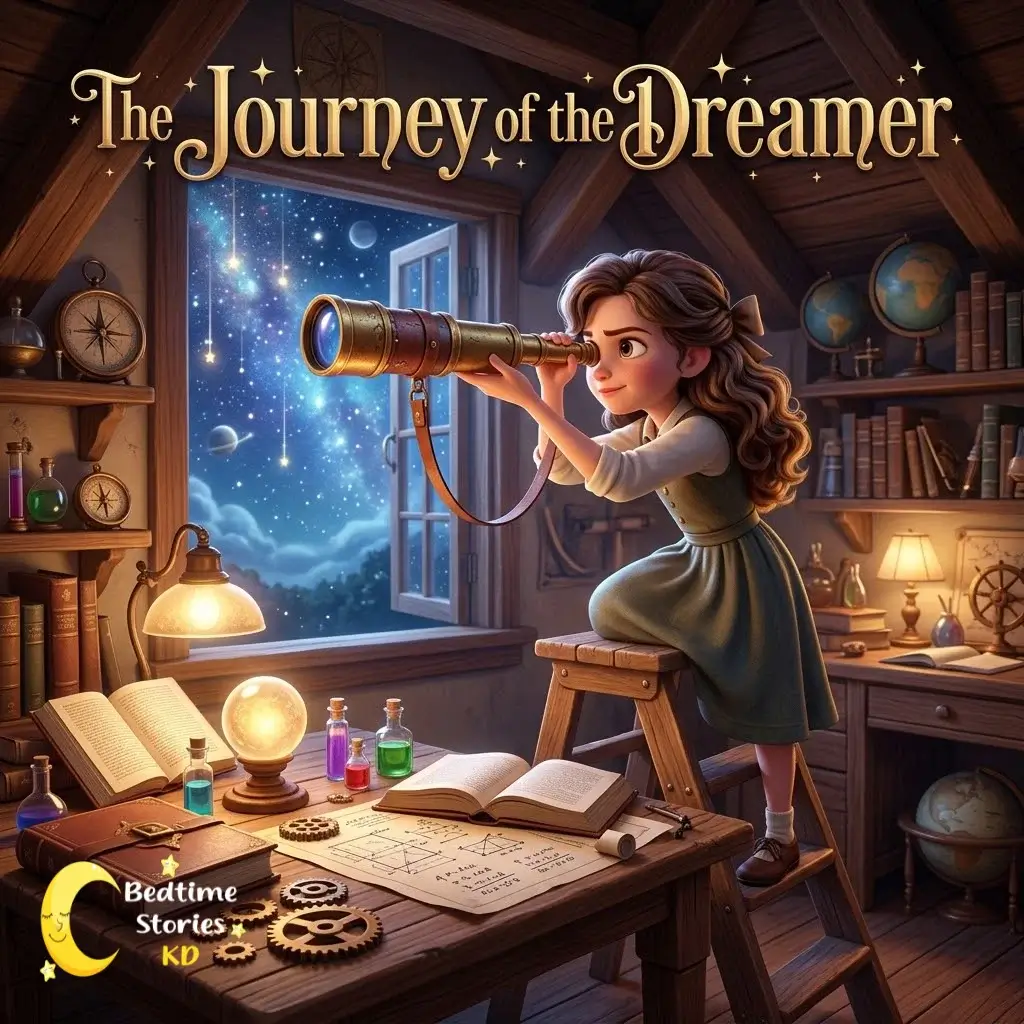
Once upon a time, in a quiet, misty village nestled between rolling green hills, lived a young girl named Maya. While most children her age spent their afternoons playing games in the village square, Maya could always be found in her dusty attic. Her walls were covered not in posters of pop stars, but in hand-drawn maps of constellations and lunar phases. Maya didn’t want to be a princess or a celebrity; she wanted to be a renowned astronomer and discover new worlds beyond the stars.
Her biggest dream was about to present itself. The Great Silver Comet, a spectacular celestial event that only occurred once every hundred years, was scheduled to pass over their village in exactly one month.
But Maya had a problem. To see the comet’s icy tail in full detail, she needed a high-powered telescope. Buying one was impossible—they were far too expensive. So, Maya made a bold decision: she would build her own telescope from scratch.
For weeks, Maya scoured the village for materials. She traded her allowance for thick brass pipes from the local plumber. She collected discarded gears from the town’s clockmaker. Most importantly, she spent hours carefully grinding and polishing thick pieces of raw glass by hand to create her magnifying lenses. Day after day, she worked tirelessly in her small attic laboratory, covered in dust and grease.
However, building a precision instrument was incredibly difficult. When she finally assembled her telescope for the first test, she pointed it at the moon. She eagerly looked through the eyepiece, expecting to see crisp craters. Instead, she saw a blurry, distorted gray blob. Frustrated, she tried to adjust the brass gears, but her hands slipped. The heavy pipe crashed onto her desk, and her carefully polished primary lens cracked right down the middle.
The noise drew the attention of some older kids passing by her house. When they saw her broken invention through the window, they laughed. “Science is too hard for a kid, Maya!” one of them shouted. “Leave the astronomy to the professionals. You’re just wasting your time with junk.”
Maya felt a heavy knot in her stomach. She looked at her cracked lens and her bruised hands. For the first time, she truly doubted herself. Feeling defeated, she threw a dark tarp over her ruined project and decided to give up. The Great Silver Comet was only a week away, and she had nothing to show for her hard work.
The very next morning, an unexpected visitor arrived in the village. It was Dr. Aris, a traveling scientist from the national university, looking for a clear vantage point to observe the upcoming comet. While buying supplies, he heard the villagers whispering about the young girl who had tried and failed to build a telescope. Intrigued, he knocked on Maya’s door and asked to see her laboratory.
Maya reluctantly pulled the tarp off her broken invention, expecting him to laugh just like the other kids. But Dr. Aris didn’t laugh. Instead, he carefully examined her blueprints, her brass gears, and the cracked glass.
“Do you know the secret of every great scientist, Maya?” Dr. Aris asked gently, setting the glass down.
Maya shook her head, looking at the floor. “That they are smart enough to never make mistakes?”
“Exactly the opposite,” Dr. Aris smiled. “They fail more times than anyone else. But they don’t call it a failure; they call it data. Every time your telescope breaks, you learn exactly what not to do. The only true failure is leaving the tarp on.”
Those words ignited a spark in Maya’s chest. She realized that her cracked lens wasn’t the end of her journey; it was just the first rough draft.
With renewed determination, Maya got back to work. She stopped getting angry when things went wrong. Instead, she took meticulous notes. She realized her first gear system was too stiff, so she oiled the clock pieces. She realized her glass was too thick, so she spent three sleepless nights polishing a brand-new lens until it was perfectly curved. Dr. Aris didn’t build it for her, but he sat in the corner, offering quiet encouragement as she learned from every single mistake.
Finally, the night of the Great Silver Comet arrived. The entire village gathered in the town square, looking up at the sky. With the naked eye, the comet looked just like a tiny, blurry smudge of chalk.
Up on the highest hill, Maya stood next to her heavy, brass telescope. She adjusted the newly oiled focal dial, her hands steady and confident. She took a deep breath and looked through the eyepiece.
There it was. It wasn’t a blurry blob. It was crisp, clear, and breathtakingly beautiful. She could see the glowing core of the comet and the long, sparkling trail of ice and stardust sweeping across the dark universe. Her telescope worked perfectly.
Maya called down to the villagers, inviting them to come up the hill. One by one, the people who had doubted her—including the kids who had laughed—looked through her invention. They gasped in awe at the beauty of the universe, made visible only because a young girl refused to quit.
Maya’s dedication had paid off. Years later, her blueprints were shared with schools across the country, and she became the renowned astronomer she always knew she could be.
Maya’s journey teaches us a powerful lesson: no obstacle is too daunting when you embrace your mistakes. Success isn’t about getting it right the first time; it’s about having the courage to try again, slightly smarter than before. Your dreams are waiting for you to build them, one try at a time.
The Educational Value of Perseverance
In every academic or personal challenge lies a profound opportunity for growth. When students listen to narratives where the protagonist struggles and eventually overcomes a hurdle through effort, it normalizes the feeling of frustration. It reminds young learners that setbacks are not the end of the road, but rather a necessary stepping stone closer to success.
Educator & Parent Tip: After listening to Maya’s journey, ask your student: “Can you think of a time when you wanted to give up on a hard homework assignment or a new hobby, but you kept trying?” Connecting the story to their own life builds confidence and resilience.
Explore More Inspiring Tales Looking for more heartwarming and empowering stories for students? Visit our main library at Bedtime Stories for Kids to discover our full collection of motivational audio journeys designed to ignite imagination and build character.