



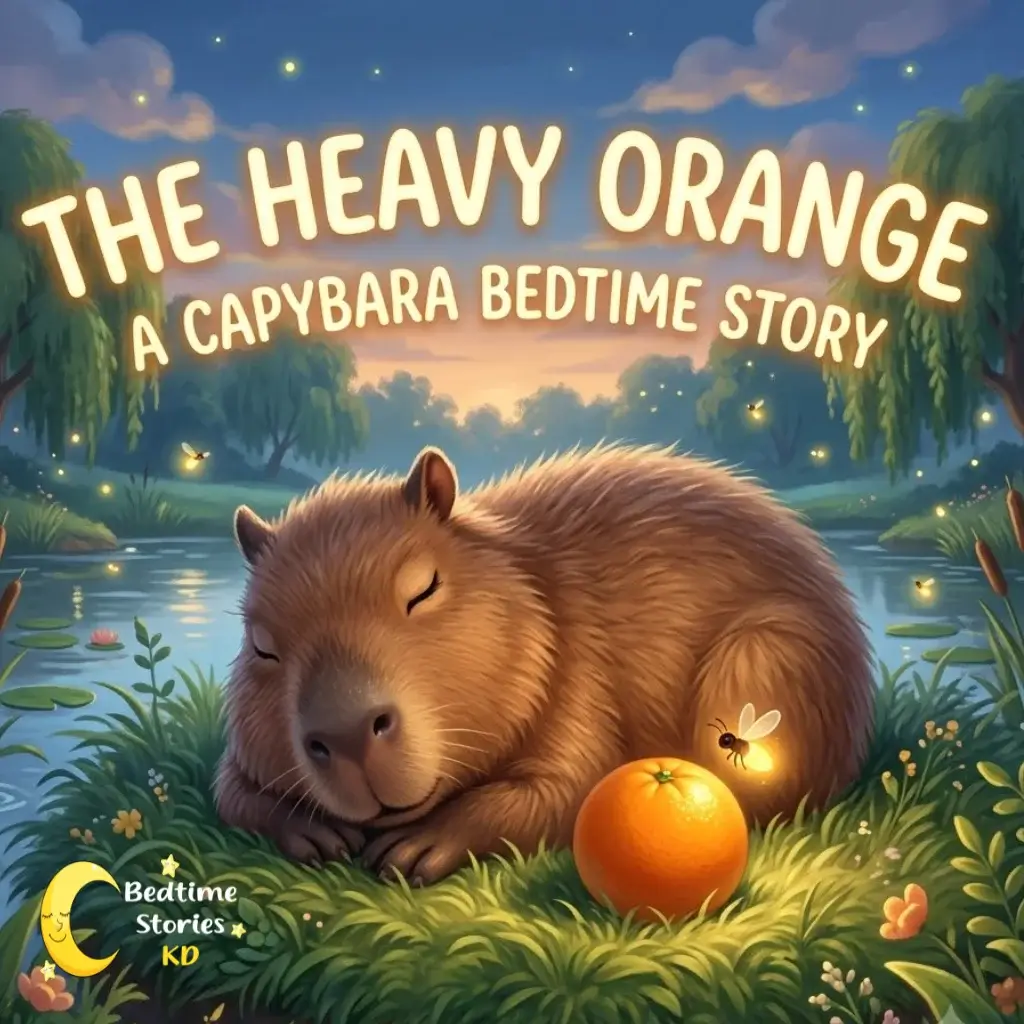

Are you looking for a deeply relaxing capybara bedtime story to help your active toddler calm down and transition into a peaceful night of sleep?
Toddlers between zero and four years old need a gentle narrative hook to capture their attention before they can truly relax. The most effective way to induce sleep is by introducing a very simple, safe problem that gets solved quickly. Once the character feels relief, their body naturally relaxes. Capybaras are famous for being the calmest animals in the world, making them the absolute perfect guides for a physical wind-down routine.
Barnaby and the Heavy Orange
Once upon a time, next to a very quiet and still pond, lived Barnaby. Barnaby was a very calm, friendly, and round capybara with thick brown fur. He loved to spend his afternoons walking slowly near the water. His absolute favorite thing to do in the whole world was to carry a small, round orange perfectly balanced on top of his flat head.
Barnaby walked carefully. Step. Step. Step. He kept his head very still so the orange would not fall. But suddenly, while he was walking near a group of smooth grey rocks, he tripped just a tiny bit. The orange rolled off his head and fell gently between two large rocks.
Barnaby stopped. He looked down. His favorite orange was stuck! It was not a scary problem, but it was a very important problem for a little capybara.
He had to use his energy to get it back. Barnaby lowered his large, heavy head. He pushed his soft, square nose between the rocks. He pushed slowly. He pushed a little harder. Finally, with one big, slow push, the orange popped out! It rolled safely onto the soft green grass.
Barnaby smiled a happy capybara smile. He felt a wonderful wave of relief. His orange was safe. But as he looked at the quiet pond, he suddenly realized that pushing the heavy orange had made him incredibly tired. He had used all of his daytime energy to solve the problem. His thick legs felt very, very heavy. His neck felt tired from pushing.
Barnaby decided it was time to stop, slow down, and prepare for a long, deep sleep. He picked up his orange gently with his mouth and walked very slowly toward his favorite resting place. He walked to a quiet spot where the grass was incredibly thick and soft.
He placed the orange carefully on the ground. Then, he needed to relax his tired muscles. He stretched his heavy front legs all the way forward, reaching as far as he could. He stretched his heavy back legs straight out behind him. He felt a deep, calming wave of relaxation travel all the way from his nose to his little tail.
Before going to sleep, Barnaby needed to wash his face. He lifted his heavy right paw and slowly cleaned his soft cheeks. He moved his paw over his ear. One time. He moved his paw over his nose. Two times. The slow, rhythmic movement made his eyes feel incredibly heavy. He closed his eyes halfway, feeling totally safe and completely calm.
Barnaby stepped slowly onto the softest patch of grass. He turned around in a slow, careful circle. One slow circle. Two slow circles. Then, he let his large, heavy body sink completely into the soft ground. He tucked his front paws safely under his chest. He took a long, slow breath of the quiet evening air. Breathe in, breathe out.
His tired eyes were completely closed. The pond was perfectly still. Barnaby the capybara was totally safe, wonderfully warm, and completely relaxed, drifting away into a deep, beautiful, and restorative sleep.
Parent Guide: The Magic of Problem and Relief
Why does this capybara bedtime story work so well for a nightly toddler routine? Young children process emotions physically. When they listen to a story about a character solving a small problem (like getting a toy or an object unstuck), they experience a mild spike in focus, followed immediately by a wave of relief.
By sharing a story that channels that wave of relief directly into a physical wind-down routine—stretching tired muscles, washing rhythmically, and turning in slow circles before lying down—we provide a powerful psychological cue for children to lower their own energy. Following the deliberate, heavy, and incredibly slow movements of the calm capybara naturally lowers your child’s heart rate. This mindful approach builds a profound sense of safety and provides the perfect biological atmosphere for restorative sleep.
If your little one enjoyed this relaxing capybara bedtime story tonight, discover our full collection of bedtime stories for toddlers and kids to build the perfect peaceful nighttime routine.
🖍️ Want more quiet time activities? Discover our interactive digital designs! Your kids can get creative, color cute capybaras online, and download their beautiful art. Perfect for a calm afternoon: Interactive Capybara Coloring Pages